
DNA Samples
When you're considering carrying out a DNA test, the question of the type of sample to provide is essential. The quality and reliability of your test depend directly on the quality of the sample collected. This comprehensive guide explains everything you need to know about DNA samples: from standard buccal swabs to discrete samples, including best practices for collection and storage.
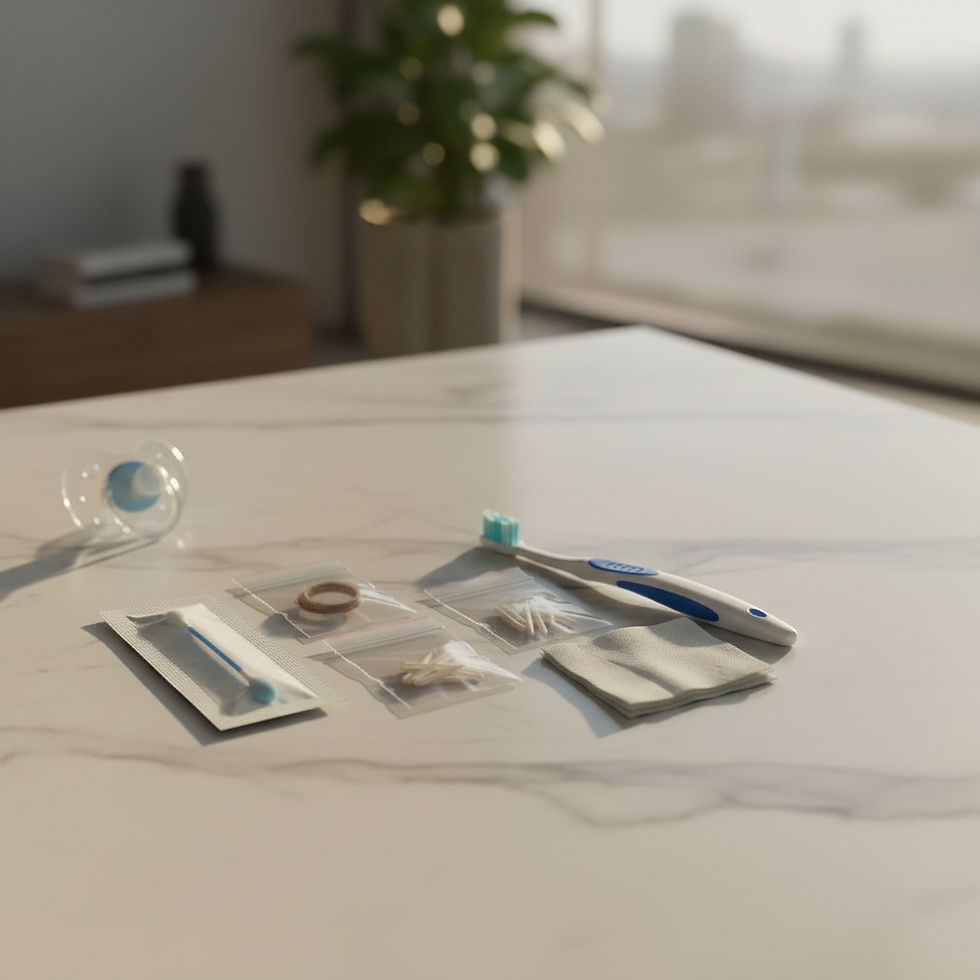
What are the two types of DNA samples?
Laboratories distinguish two main categories of genetic samples, each suited to specific situations.
Buccal swabs (standard samples)
Buccal swabs constitute the standard collection method for any DNA test. They are systematically included in your collection kit when you order, at no additional cost. These saliva samples offer a very high DNA extraction rate and guarantee reliable results. Their use is simple, non-invasive and can be performed at home by anyone, without medical assistance.
Non-standard samples (discrete samples)
Non-standard samples include all supports or items that may contain DNA usable by a laboratory: hair, nails, personal items, etc. These samples are particularly useful when buccal swabs cannot be used. Depending on your situation and the type of test desired, you can choose the sample most suited to your needs.
The Standard DNA Collection Kit
What does a DNA collection kit contain?
When you order a DNA test online, the laboratory sends you a complete kit containing everything necessary to carry out your collections at home, in complete simplicity.
Kit contents:
4 buccal swabs per participant
Detailed collection instructions
Consent forms to be completed obligatorily by each participant
Laboratory details and contact information
Individual envelopes for each set of swabs, with space to identify the participant
A pre-addressed return envelope (caution: dispatch costs are not always included)
Important: Consent forms must imperatively be completed and transmitted to the laboratory. Without these documents, no analysis can be performed. Never reuse the original swab packaging after collection.
How to perform a reliable buccal collection?
The best time to collect
The ideal moment to carry out your collections is in the morning, a few moments after waking. At this time, you are fasting and have ingested nothing for several hours, which guarantees sample quality.
Preparation before collection
All participants must follow these instructions at least one hour before collection:
Do not eat or drink (except water)
Rinse mouth with lukewarm water only
Do not use toothpaste, mouthwash, alcohol or tobacco
Step-by-step collection procedure
Collection: Rub the inside of your cheek with the swab cotton for 30 seconds to 1 minute, making firm circular movements.
Drying: Leave the swab to dry for 1 hour in the open air, indoors. Never touch the cotton part with your fingers. You can use a clean glass by placing the swab inside, cotton facing upwards.
Storage: Once dry, place the swab in the individual envelope provided in the kit.
Repetition: Repeat the operation 4 times per participant, taking scrupulous care not to mix swabs from different participants.
Non-Standard Samples (Discrete Samples)
In certain situations, using buccal swabs proves impossible or inappropriate. This is why laboratories offer to analyse alternative samples, called non-standard or discrete samples.
What is a discrete sample?
A discrete sample can take an infinite number of forms. The laboratory is capable of extracting DNA present on practically any type of support. Two main categories are distinguished:
Direct samples come directly from the person: hair with root, nails, blood samples (tube or stain), semen (condom or stain), medical samples, dental sample, biopsy, muscle tissue, bone, ashes…
Indirect samples are objects that have been used, consumed or handled by the person: toothbrush, hairbrush, razor, glasses, cigarette ends, chewing gum, tissues, cotton buds, toothpicks, sanitary towels, condoms…
How much does analysis of a discrete sample cost?
Using a non-standard sample represents a paid option. In the vast majority of cases, a supplement will be charged to analyse this type of sample. Moreover, DNA extraction is never guaranteed 100%.
Caution: Any inconclusive extraction attempt will be charged. If the laboratory fails to extract sufficient DNA, you will need to pay again to continue analyses with new samples. It is therefore strongly recommended to favour buccal swabs when possible, or to carefully choose your sample before sending it.
Why choose a non-standard sample?
Discrete samples respond to specific situations where standard saliva samples cannot be used.
Common situations:
Participant unavailability: The person concerned is not available or accessible to perform a buccal collection.
Need for discretion: You wish to carry out a DNA test without the person concerned being informed.
The discrete DNA test: a delicate solution
In certain complex relationship contexts, carrying out a DNA test discreetly can be a solution in the face of doubt or mistrust, without abruptly revealing potentially compromising results. Sometimes, carrying out a DNA test or announcing results can be difficult to experience or inopportune. Discrete samples allow progress to be made serenely when the question of biological filiation arises seriously.
Important on the legal and ethical level
Participants' consent is theoretically necessary for any DNA test. Although the laboratory cannot directly control this aspect, participants take full responsibility regarding the samples they send.
Using a non-standard sample will always be considered an anonymous test and can never have legal value.
Caution: Analysis of genetic fingerprints without the consent of the sampled person carries a criminal sanction, whatever the country. The offender who uses discrete samples without consent fully engages their responsibility.
How to Guarantee the Reliability of Your DNA Samples?
The reliability and authenticity of a filiation DNA test depend on three essential factors:
The quality of samples provided
Laboratory accreditation and seriousness
The choice of test suited to your family situation
Understanding the DNA extraction process
When a laboratory receives a sample, the first step consists of extracting DNA from the support sent in order to create the person's genetic profile. Not all samples provide the same success rate during this extraction.
Extraction quality depends on several factors: sample storage, collection date, and above all sample type. It is much easier to extract DNA on direct samples or on supports containing bodily secretions such as a blood stain, semen, mucus or earwax.
What is a reliable sample?
A reliable sample provides sufficient usable genetic information to carry out the ordered DNA test, without major extraction difficulty.
Reassuring point: A poor sample can never provide a false result. Here's what happens:
If your sample doesn't contain enough genetic information, the laboratory will ask you to provide a new sample to continue analyses.
If you receive your results, this means your samples have been correctly analysed, that collections proceeded properly and that a complete genetic profile has been established.
Best practices for a reliable sample
1. Favour recent samples
Where possible, avoid using samples that are too old (several years), as they present a very high degradation risk. DNA does not remain indefinitely on a support, and numerous external factors can accelerate its degradation.
2. Ensure proper storage
Sample storage is a key element before dispatch to the laboratory.
Storage rules:
Always store your samples in paper envelopes
For bulky samples, use cardboard boxes
Never use plastic bags or containers for storage or dispatch
Before collection, ensure the sample was in favourable conditions
A humid place, outdoors, or in contact with liquids can very quickly deteriorate DNA. In case of doubt, try to find another sample. Supports in contact with coffee, tobacco or toothpaste offer a much lower extraction rate.
3. Avoid all contamination
To prevent contamination of your sample, never handle it with your fingers. It is strongly recommended to use gloves during collection.
What happens in case of contamination?
Sample contamination by another DNA appears during analyses. It then becomes very difficult for the laboratory to determine to whom the genetic information found on the support belongs. However, it is generally possible to determine whether contamination originates from a male, female or other profile.
If the sample received by the laboratory is deteriorated or contaminated, the analysis procedure stops. The laboratory will then request re-sampling with dispatch of a new kit. A poor sample can never compromise result reliability.
Recommended Discrete Samples: Detailed Guide
Here is the list of the most reliable non-standard samples, with their specificities and lifespan.
Blood sample
Blood is the best support for DNA extraction and allows a genetic profile to be obtained with certainty.
Accepted formats:
Blood tube: After blood collection, it must be sent in a tube designed for blood storage during transport.
Blood stain: The stain must measure at least 1 cm diagonally. Accepted supports are: fabric, paper, compress, clothing, sanitary towel. Caution, not all supports are usable. Always allow blood to dry before dispatch.
Lifespan:
Liquid blood in tube: 15 days
Dry blood stain: 3 to 4 months (depending on storage)
Seminal fluid (semen)
Semen can be sent on an absorbent support, a wipe or in a condom. Imperatively allow the sample to dry before sending it to the laboratory, but never place it in a plastic bag.
Lifespan: 3 to 4 months (depending on storage)
Nails
The laboratory needs 5 to 10 nail pieces to perform a DNA test. Favour toenails rather than fingernails, as the latter can be polluted in daily life. Nail varnish or any other cosmetic product does not affect analyses.
Lifespan: Depending on storage, nails always preserve DNA, but degradation can appear 6 months after collection.
Hair sample (hair)
The laboratory needs 5 to 10 hairs with root to perform a DNA test. It is impossible to
use cut hair or hair without bulb, as genetic information is located in the hair follicle at the hair extremity (the living part). You can recover hair with root from hairbrushes, for example.
Lifespan: Depending on storage, hair always preserves DNA, but degradation can appear 6 months after collection.
Used cotton buds
Ensure the cotton bud has not been used by several people and that earwax is present in sufficient quantity. You can send several samples to increase your chances of success. Never handle the cotton with your fingers and allow it to dry before sending it in a paper envelope.
Lifespan: 1 to 2 months (depending on storage)
Used tissues
You can recover a used tissue in paper or fabric. Allow it to dry before storing it in a
paper envelope. Send the sample to the laboratory quickly after collection.
Lifespan: 1 to 2 months (depending on storage)
Toothbrush
The toothbrush is the simplest and most discrete sample to recover. However, the DNA present can easily be deteriorated by contact with toothpaste.
Collection advice:
Ensure no one else has used the toothbrush
Verify that the person doesn't rinse their brush with toothpaste after use
Recover it immediately after use
Allow it to dry before storing it in a paper envelope
Lifespan: Up to 1 month (depending on storage)
Which DNA Tests Accept Discrete Samples?
Tests compatible with non-standard samples
The following tests accept the use of discrete samples for one or more participants:
Good to know: It is not obligatory that all participants send the same type of sample. You can combine different samples according to participants: buccal swabs for one, hair for another, nails for a third. This will have no impact on result reliability.
Tests incompatible with discrete samples
Certain tests imperatively require specific sample types and do not accept non-standard samples:
Prenatal paternity test: Obligatorily requires blood tubes for the mother and buccal swabs for the father
Mitochondrial DNA test: Only buccal swabs
Test to determine baby's sex: Only blood tubes
Genealogy test: Laboratories generally recommend standard buccal samples